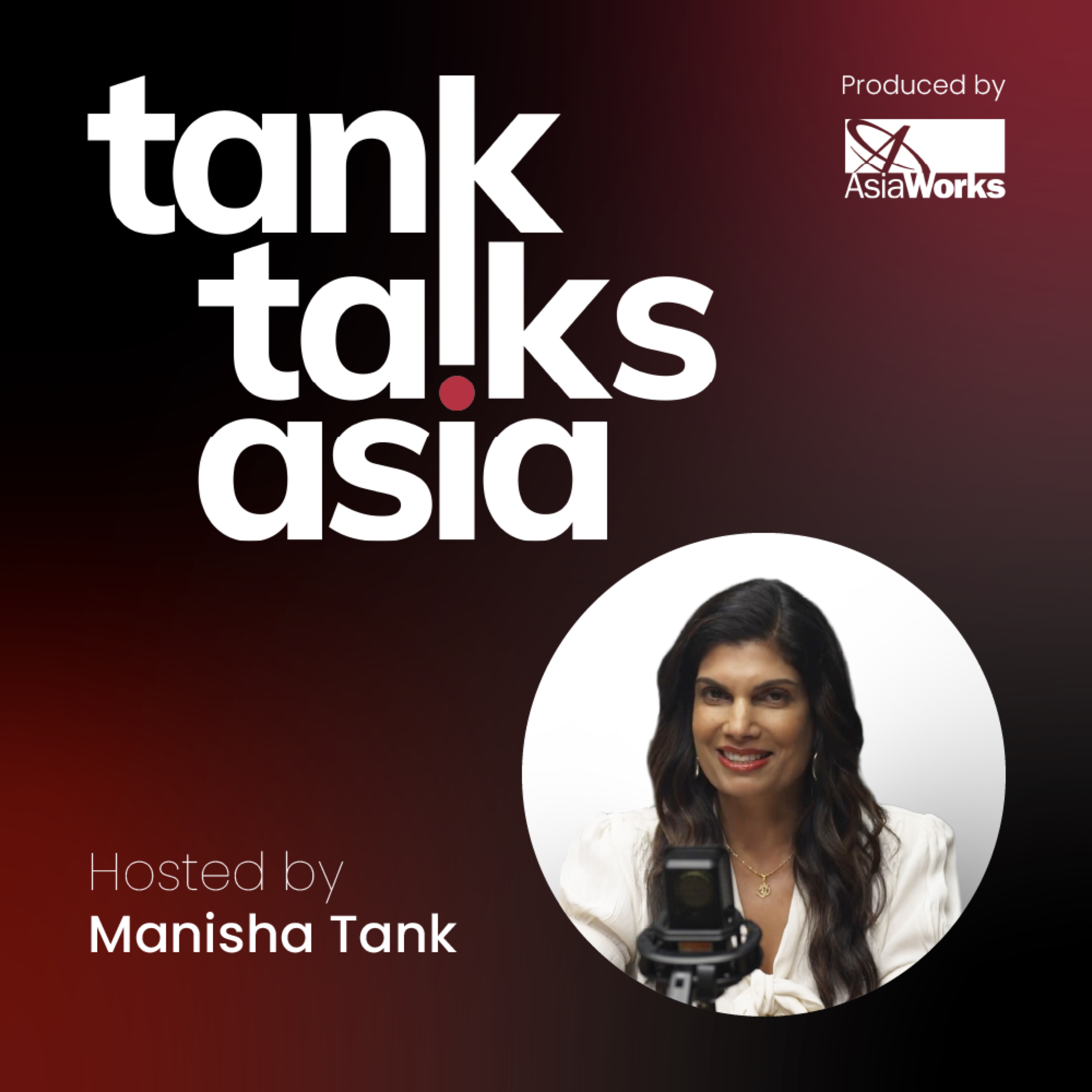
Episode 31
Bigger than AI: The #1 Threat Bosses Face in 2026 | Maha El Dimachki, GFTN | Talk Talks Asia
In this episode of Tank Talks Asia, Manisha talks to Maha El Dimachki, CEO of Solutions at the Global Finance and Technology Network (GFTN), to unpack the future of global fintech.
Maha also shares her insider’s view on how technology is reshaping global finance and economic access, and what she believes the future holds for jobs in an increasingly automated world.
Featured Voices
Hosts: Manisha Tank
Guests: Maha El Dimachki, CEO of Solutions, Global Finance and Technology Network (GFTN)
Key takeaways
- Maha explains why she believes fintech is capable of solving practical problems in areas such as agriculture, healthcare and access to credit.
- She says technologies including AI, blockchain, tokenisation and open finance could expand access to financial products and make them more affordable.
- Maha talks about how regulators need to strike a balance between allowing innovation to develop, while also staying close enough to emerging technologies to understand and manage the risks.
- She argues that companies need to develop “AI fluency” and understand how AI is being deployed.
- Maha believes Asia's biggest challenge is creating jobs for a growing population of young people, and is hopeful that collaboration between governments, businesses and organisations can help address it.
Chapter heads
The Future of Financial Services
Maha explains what she does at GFTN Solutions and why creating jobs, developing skills and building supportive ecosystems are at the heart of her work.
From Sydney to London to Singapore
She reflects on more than 25 years in finance, talking about the experiences that shaped her career, including her time at the UK’s Financial Conduct Authority.
Making Finance Work in the Background
Maha and Manisha discuss how technology has transformed everyday banking and how financial innovation can connect technology with practical challenges in areas such as farming, healthcare and financial inclusion.
The Technologies That Could Change Finance
From blockchain and tokenisation to AI and open finance, Maha looks at the technologies she believes could unlock new opportunities and make financial services more accessible.
How Should Regulators Respond?
Maha explains the balancing act regulators face as technologies such as AI and quantum computing develop at unprecedented speed.
Why Businesses Need AI Fluency
She argues that companies need to understand the risks and implications of AI for themselves, with boards playing a central role in deciding how the technology should be deployed.
Can Regulation Be a Friend?
Maha challenges the idea that regulators are simply there to get in the way, arguing that startups and scale-ups can use regulation to build stronger, more trusted businesses.
Cutting Through the Fintech Jargon
The conversation turns to acronyms, jargon and the importance of explaining financial technology in terms that everyone can understand.
Payments, Geopolitics and Sovereignty
Maha traces the evolution of payments from traditional banking to neobanks and digital wallets, and explains why geopolitical shifts are making homegrown payment systems and financial sovereignty increasingly important.
The Five Rewirings
Maha previews the themes shaping this year’s Singapore FinTech Festival, from technology and geopolitics to talent, policy and capital, before returning to the question of how Asia can create jobs for its youth.
Useful links
https://www.deloitte.com/uk/en/Industries/financial-services/perspectives/fintech-glossary.html
https://www.bankofengland.co.uk/explainers/what-is-a-central-bank-digital-currency
https://www.youtube.com/watch?v=3u1lIKhHhZQ
https://www.fintechfestival.sg/
Don’t miss out
We’re on a mission to bring the real Asia — its thinkers, builders, dreamers, and disruptors — to global ears. So if you know someone who would be a great guest or want to contact the team, please email:
And don’t forget to follow, subscribe, and share so you don’t miss the next episode of Tank Talks Asia.
Tank Talks Asia is an AsiaWorks production.
Transcript
TTA EP31 MAHA
MAHA: We like to bamboozle people with words. I guess maybe a lot of industries have it, you know, it becomes very, I don't know, very customary to use, to use jargon. And the bigger the word, the more impressive it is.
I keep telling people, "Look, if you can't explain this to your mother in words that she would understand, then maybe we're not doing the right thing here."
MANISHA: You were just hearing from Maha El Dimachki, a much revered voice in the world of financial technology. You know, I'm old enough to remember a time when walking into your local bank was the only way to pay in a check or maybe withdraw cash from your account. Well, today we can do everything on our phones, can't we?
Technology is spurring innovation, revolutionizing the way that we manage our livelihoods, and has the potential to lift hundreds of millions out of poverty. But that's only if you get the rules around it right.
Welcome back to Tank Talks Asia. Today, we're pulling back the curtain on the forces driving the next wave of global finance. Joining us is a leader who is right at the heart of this transformation, Maha El Dimachki, the CEO of Solutions at the Global Finance and Technology Network, or GFTN.
So Maha, welcome to the show. It's good to have you here across the desk.
MAHA: It's great to be here.
MANISHA: CEO GFTN Solutions. It sounds very high-flying, but what does that mean?
MAHA: You know, we're living in a, in an era where there's potentially going to be job losses. We talk about it all the time, and what's really important is how do we create jobs for the youth, actually for everybody.
So a lot of what Solutions actually focuses on is what are the initiatives that we can put in place that can get to that target? And it sits across three pillars. One is looking at the policies that will support an ecosystem that can create jobs.
How do you enable that ecosystem to thrive, and how do you ensure that you've got the talent, skilled, up-skilled, to engage in that ecosystem? So capacity building, skills development, ecosystem enablement with things like incubators, accelerators, entrepreneurship sort of pathways and the policy has to support that. So those three things together is what basically Solutions does.
It's all the boring grunt work on the ground but actually highly rewarding because you see the outcomes, and the outcomes is not something that is unlocked, you know, overnight.
MANISHA: Okay. But you've been in finance for a really long time.
MAHA: I have been. More than 25 years now.
MANISHA: And it's a career that's spanned different continents. You've been Sydney, London, Singapore. Which would you say has made the biggest impact?
MAHA: Oh, gosh. I mean, I moved to London for various reasons, personal and professional, but London is a financial hub. I mean, I was so excited when I moved to London.
You know, my first couple of nights I'd walk around thinking, "I can't believe I'm in this city." And had this great opportunity with the Financial Conduct Authority, spent a number of years there. And I feel like that really unlocked where I am today. So I think I'm very grateful for London and the UK.
MANISHA: But Singapore's also been amazing for you. What have you enjoyed the most about being here so far?
MAHA: Singapore is a great place to be.It's thriving, it's cosmopolitan, it's multicultural. And for the work that I do, which is financial innovation, innovation in financial services, I mean, there's so much that Singapore is doing, punching above its weight. I mean, so impressive.
MANISHA: You know, I've worked with GFTN now for more than 10 years, hosting the Singapore FinTech Festival, or at least one of the stages. And what I've learned is we don't talk enough as laypeople about how important fintech is to managing our livelihoods.
You sit right at that junction, and for me, looking at you, listening to you, I sort of think that must be one of the most exciting parts of it, is this is so integrated with people's lives.
MAHA: It's one of my key missions, is that I want to break things down when we talk about technology, when we talk about financial services, such that everybody understands it, because it does impact all of our lives. I kind of always talk about finance not as an industry, I tell people it's not an industry in and of itself. It fuels the economy.
Transaction happened because of financial services, and let's think about how it really links into the real economy. So imagine, you know, innovation happening in the agri-business world, in, you know, farming. You know, imagine satellite data that will allow you to understand, you know, what is the rainfall sort of prediction. You can harvest at the right time. You end up with better outcomes for your crop.
How does that translate to a higher score on your credit scoring so you can get loans? You know, if we're thinking about innovation in healthcare, right, how does that translate to lower premiums for your insurance?
MANISHA: Yeah.
MAHA: So you can see how it links into the real world, and those are the cases that I get excited about.
MANISHA: Yeah.
MAHA: How do we create entrepreneurship and fintech, financial innovation, that will solve some of these real-world problems. That's what gets me out of bed every day.
MANISHA: I'm old enough to remember a time where you walked into a bank, you bank a check, right? If you wanted to get a mortgage, you actually had to sit down and have a face-to-face meeting with someone. Today, it's a completely different experience. You can literally do everything on your phone. You pay for things with your phone. You can get new financial products through your phone.
MAHA: Yeah.
MANISHA: But then it creates this really disconnected relationship, not seeing another human face when you're deploying some of your hard-earned cash. Something that you've put your heart and soul into. I worry about that a little bit. Is there a problem there?
MAHA: Let me give you my story, my similar story to what you just said. 25 years ago, what is the quickest way to move money from London to, let's say, New York? The quickest.
You take the cash out of the ATM or maybe go to the bank and pick it up, you get on a plane, and you actually take a flight to New York. That was the quickest way, and I'm not talking about cost, I'm talking about the speed. That was the quickest way to move money from London to New York.
The world has changed so much. I love the fact that I don't go into a branch.
MANISHA: Okay.
MAHA: Because we also have busy lives, and what I would like, my vision for financial services is that it's something that just functions very well for you to be able to live the life that you want to live.
So make connections, but not necessarily with your bank manager. You know, make connections with other people, your work mates, you know, every- everybody else, and finance can just work in the background for you. And that's what financial innovation can do.
If you're reaching rural communities, how can we use technology to do that? Now, obviously, there's upskilling that's needed, but everybody's got mobile phones these days. Gamification, all of these games and rewards and so on, on phones, also keeps us engaged. Maybe some of it goes too far at times, but there's always a benefit to certain technologies.
The technology is there. The policy needs to follow, and I think today more than ever it is achievable.
MANISHA: So you're there at the forefront of these solutions. But of those that have crossed your desk, of the conversations that have come up in the boardrooms, which ones do you think in the here and now are the most revolutionary?
MAHA: I mean, the technologies that are most revolutionary, harnessed the right way is, you know, blockchain, DLT tokenization, and the reason I say that is because you could fractionalize it.
Imagine whenever I want to put up my property as collateral, the whole property goes up as collateral. Imagine if I just need to fractionalize a tiny bit of it. There's something really safe in knowing that you can do that. But then you also allow for the fractionalization of an asset for everybody else to access it as well.
So that's one very immediate, you know, outcome, that if we get tokenization right in the financial system, that can unlock so many opportunities. AI. AI could be really harnessed for, you know, efficiency gains in the backend. If you create efficiencies there, that means you can create, you know, more cost-effective products that can go out to more people.
Now, I keep saying it's expensive to be poor. Because goods and services are, the underlying cost of them is high, and those with lower incomes can't afford them, or they, you know, obviously, the credit scoring is another element as well.
But again, AI can help with that, it can, open banking, open finance can help with how you can take other sets of data and understand various behaviors and be able to change or adjust the credit scoring, or at least test out what that would look like if you lend to other segments of society that you haven't in the past.
MANISHA: Up ahead, what do regulators actually regulate and why?
MANISHA: We were both at the same conference six weeks ago and I heard this quite shocking statement on stage, which was, you gotta think about what happens when you put quantum computing alongside AI and the potential risk. You've got to be close to that technology. You've got to understand the consequences and the implications of leveraging it.
MAHA: You never wanna be ahead of the curve as a regulator. You wanna see what the market is doing, allow it to innovate and sometimes some things kind of pop up and disappear, and so there's no need for you to deploy very valuable public resources to this. So they have a very important balancing act between how they use their resources to, you know, discharge their duties versus where they really need to kind of lean in and act.
And every market has its different dynamics in terms of market structure, political structure, and so on and so forth. So they all will respond slightly differently. But in terms of, you know, they don't need to be ahead of the game, but they can't be too far behind because the risks with these technologies are just as high as the opportunities.
And I've seen really great examples of where regulators put their hand up and say, "We don't understand this." You know, and they've invited industry to come in and talk to them about the technologies, talk to them about their business models, how they're using it, where the risks are, so they can understand, and they've done various sort of initiatives around this, and I think that's a very mature way in which, you know, regulators can engage with industry, setting up these public-private partnerships.
I think staying as close as possible to, you know, where the technology is moving is very important. It is difficult, though, because when you look at AI, it's moving at a speed that none of us can comprehend. But exactly to your point, when quantum comes in, it's going to supercharge all of these a thousandfold more, and that is scary.
MANISHA: Yeah.
MAHA: The opportunities are great, but the risks are also great.
MANISHA: For those who are listening and watching who sort of worry about that, the implication of that, what would you say to them?
MAHA: I think understanding what these technologies are and when there is a black box, actually understanding what the implications of, you know, implementing such models is very important. Some more high-stakes, high-risk type of decisions, you have to tread that very carefully.
So that allows you to then to set your risk appetite, and then across the various functions, particularly the various sort of tasks and operations, levels of operations that you do in the business, and you can assess what is the risk appetite across all of these. With that, you can then decide how you deploy AI.
And so, there's one thing to rely on the regulator to potentially sort of, you know, tell you what to do, but there's also, it's risk management. These are very mature decisions that need to take place at the top of the house. Any company, if their board is not engaged in how you are deploying AI, particularly now the, you know, the more agentic and, to your point, the various models that explainability is a problem, and the black box happens, your board has to be absolutely engaged.
They need to understand what this looks like. I think everybody needs to understand at least how to critique AI. I keep talking about fluency in AI. You don't have to code to be fluent in what AI is, where it's come from, how it works, and therefore what questions you need to ask.
So if organizations aren't equipping themselves from the board all the way through to, you know, the various ranks of their operations with that knowledge and skill set, they should.
MANISHA: Maha, like I said earlier, you've been in this game a while. You've even written a book, Fintech Regulation in Practice.
What would you say is a huge myth that people believe about regulators that you wish they wouldn't?
MAHA: They're normal people. And they're nice people. I think, there's a little bit of a barrier, particularly when you're a startup company. You're worried about what regulators think, what they'll do, what they'll say, how might you engage them, and actually regulators just wanna listen to your story. They just want to know what your business model is.
Believe it or not, they're kind of rooting for you. They do want you to succeed but their role is to be impartial and not to back, you know, any particular horse and to keep a level playing field. But they also, you know, it's right to, to kind of set expectations for startups in particular and what I call scale-ups, so that those that are moving from kind of post-startup phase, they're moving from the kind of, let's say the 10 to 100s, your series B, Series C companies, to really think about what regulation is and how you can you use it.
Actually, and that's what I wrote in my book. You know, how can you use regulation as a friend? Think about why regulation is there. Now, we all want, you know, open, thriving, competitive, you know, high standard markets to operate in. That's where investors invest and consumers consume. We all want that. We want those high standards. That's why we go to high standard jurisdictions to get our licenses to operate and so on.
MANISHA: Yeah.
MAHA: So the regulator will see that you understand how you're applying risk management. It doesn't have to be burdensome. As you grow, your lens has to change on what are becoming high impact areas, that if they go wrong, they're making an impact to your customers and to the market.
MANISHA: Yeah.
MAHA: That's basically what regulation is. That's what regulators are asking you to do, is think about your impact and make sure that you're doing the right thing by the markets in which you're operating. If you think about it from that perspective, you see it as a friend.
MANISHA: Later on the show, jargon and fintech.
All right, so we did a bit of myth busting. Off air, we talked a little bit about language. So it's interesting 'cause when you wrote the book, you tell me that you tried to write it, with language that everyone could understand and everyone would find accessible.
I have to admit, Maha, I have never come across more jargon in the fintech space than I have anywhere else. What is this about? Like, are you experiencing the same thing?
MAHA: Makes us sound intelligent. We like to bamboozle people with words. I guess maybe a lot of industries have it and the bigger the word, the more impressive it is, I suppose. I mean, one of the things that I really guard, I really hold myself to account, I could just see, hear myself thinking about the word that I'm going to say and thinking, "No, this is, this is one of those, you know, interoperability, fractionalization, I actually used already," but, you know, I'm kind of checking myself not to use that because, again, when we're talking about financial services impacting everybody, I think that the biggest thing that we should think about is how do we make it accessible to everybody.
And that should apply across every industry, but exactly to your point, there's so much jargon in our industry that I do like to break it down. I keep telling people, "Look, if you can't explain this to your mother in words that she would understand, then maybe we're not doing the right thing here."
MANISHA: There are also so many acronyms. I think one of the big ones that comes up a lot now, of course, is CBDCs, central bank digital currency.
MAHA: Yeah, yeah.
MANISHA: Should people care or not? It's really just about can I make this payment or not, isn't it?
MAHA: People should not care. So there's always two levels to this, right? There's the function of, you know, money or the thing that we're talking about, whatever the financial services product is.
There's the function of it. You know, a loan, everybody understands a loan. We know what we're doing with a loan. It is usually a means to an end. That part, people should not care about the jargon. They should, we should, you know, make sure that it works, it works well, you know, people are safe when they're transacting.
And so whenever you go to some of our conferences, all of those people that make it work in the background that care about how it works, that care about why it functions the way it functions. If we didn't understand that, things might go wrong.
And so that's where I think the jargon sets in. As long as we keep those two very clear in our minds that we can switch from one to the other, then usually I'm okay. So dinner table conversations at my house, 'cause I love fintech regulation, you can imagine.
MANISHA: You heard it here first, everyone. Maha loves fintech regulation.
MAHA: I do. And I talk about it at the dinner table at our house, and everybody's rolling their eyes, and that's my test on whether I can get through to people or not. I don't always succeed, but I think that's kind of the test.
How can we swap from one to the other? What's important to every, you know, group, if you like, and target audience might be different, and you use the right language from there. Because I like acronyms. I mean, sometimes sentences are quite, are quite long.
MANISHA: You can't, you can't go around saying central bank digital currency all the time. It's a little long-winded, let's admit.
MAHA: People get the acronyms wrong as well. I find it quite funny 'cause it's CBDC, which I think, hmm, not really, but that's okay.
MANISHA: But on that note, actually, the conversation around the digital euro has become a really interesting anchor point for where politics and this fintech revolution meet and a reminder that when it comes to anything digital, it's borderless. And of course, different countries, different regions have different rules.
MAHA: 25 years ago when I started in payments and I was excited about it 'cause I used to say for payments to work, it's the blood supply of the economy.
And so then there was a moment where we saw that actual, you know, transaction banking, payments, where you hold your bank accounts, apparently you change spouse over your lifetime, but you don't change your bank account. And so it's really sticky.
And then it became very interesting because this is, you know, investment bankers started to want, this universal banking concept came up with a lot of large banks. I was working for Bank of America Merrill Lynch at the time, and it was really about the stickiness of these relationships. There was a lot of innovation around it.
And then post the financial crisis, then there was the disruption that came from neobanks and, you know, wallet providers and e-money providers, and that really created disruption. So then it became really interesting and innovative.
Now it's about sovereignty. You know, and you look at sort of what happened, the war in Ukraine really triggered that, and the need to ensure that whilst you want to engage with all of your partners around the world, you also have, you know, what Europe is calling a strategic autonomy.
So strategically you need to make sure that you're also, you know, your citizens can pay all the time, and you have that autonomy to be able to do that. And so that very local, homegrown payment system is very important. I'm not surprised by it, I think it's an important discussion. I guess geopolitics is shifting.
MANISHA: Coming up, what's on the agenda this year for the Singapore FinTech Festival?
ted about for us this year in:MAHA: Yeah, I learn every day just from being at GFTN, but being at places like the Singapore Fintech Festival, we had the Point Zero Forum, which is where we saw each other last.
MANISHA: Yeah.
MAHA: You learn so much from all the various perspectives around, the contrarian perspectives, the points of view that, you know, that you never, you never would have thought of. And that to me has been a highlight, the growth of Singapore Fintech Festival from where it was to where it is now.
I believe it started with 7,000 people, and now we're 70,000. It's huge growth, and people understand, I suppose, the benefit of bringing people together, and making those connections. And whilst it's a large gathering, it's highly curated, so everybody knows, has something that hopefully they can, you know, listen to, they can watch, they can engage in, that's going to be, that's going to be beneficial to them.
This year is particularly exciting, not only because I'm within, you know, GFTN, and I can hopefully help shape some of this, in terms of, you know, what the festival will bring. But we're also talking about what we're calling the rewirings. You know, five rewirings. And it's, the idea is that there's a shift in the world, and it's driven by a number of things.
Technology, at the heart. They're all interrelated, but we talk about the technology rewiring. We spoke about the speed of technology and how it's changing, you know, how we live our lives and the financial system and so on. So that's one. We have geopolitics. What does that create in terms of new economic corridors and relationships and so on?
We have talent. You know, the talent that we thought we needed for the future is no longer what, what is true. And so how do we make sure that we're adapting to the talent that's needed for the future of, you know, future of work with AI and, you know, with these new technologies? So that's the third.
Then we have policy. How we need to make sure that, you know, policymakers are really thinking about the gap. And then the fifth one is capital. So again, how is capital going to move around the world? Where are investors placing their bets? How is this going to, again, be rewired?
So those, we think, are all interrelated, but the theme of the festival actually sits around those five themes. And I think I'm excited by it. I'm looking forward to learning.
MANISHA: Coming up, where are all the jobs gonna come from?
You know, you talked about rewirement, and I think that's really interesting 'cause one of the guests that we had on the show was Piyush Gupta. Piyush talked about, and this is bringing us full circle in the conversation now because this is a part of what you do in Solutions, he said the biggest challenge for Asia is gonna be jobs.
I have asked that question of so many guests, "What do we do about the concerns that Gen Z has about its future job prospects?"
We've got a situation developing in China where there are millions of graduates, university graduates, who can't get jobs. How are you gonna provide jobs for the youth in India, for example? Six months into the role, how confident are you about that issue?
MAHA: I'm hopeful. I'm hopeful because I think, and, you know, GFTN and many other organizations who share that vision, we all need to play a role in how we create those jobs and how we contribute to creating those jobs.
It's gonna be a combined effort, but confidence is a big word, I think. I think I'm hopeful. If we move together in the right direction, then we should, we should be able to at least make a dent in this.
I mean that's what we should all aim for. So GFTN at the heart, I should say, is an impact organization. So it's something that we want to certainly get behind, and I know that there are many other really wonderful organizations in the world that will do the same, and so together hopefully we can make a difference.
MANISHA: Yeah, I love that, that positive. Maha, it's been a pleasure. Thank you we really appreciate that and we really appreciate your time, thank you.
MAHA: The pleasure's mine. Thank you so much for having me.
MANISHA: So we heard it from an expert. Fintech isn't just about payments and how they can be faster. It's about so much more than that, and hopefully it is solving one of the biggest problems of our time, and that is creating more jobs. If you're curious about anything we talked about, feel free to browse our show notes.
Thank you as always for making it to the end of this episode, recorded at the AsiaWorks studio in Singapore. Be first in line for our episodes. Like and subscribe to the show. I'll catch you on the next one. I'm Manisha Tank signing off.
Tank Talks Asia is an AsiaWorks production and the views and opinions shared by our guests are their own.