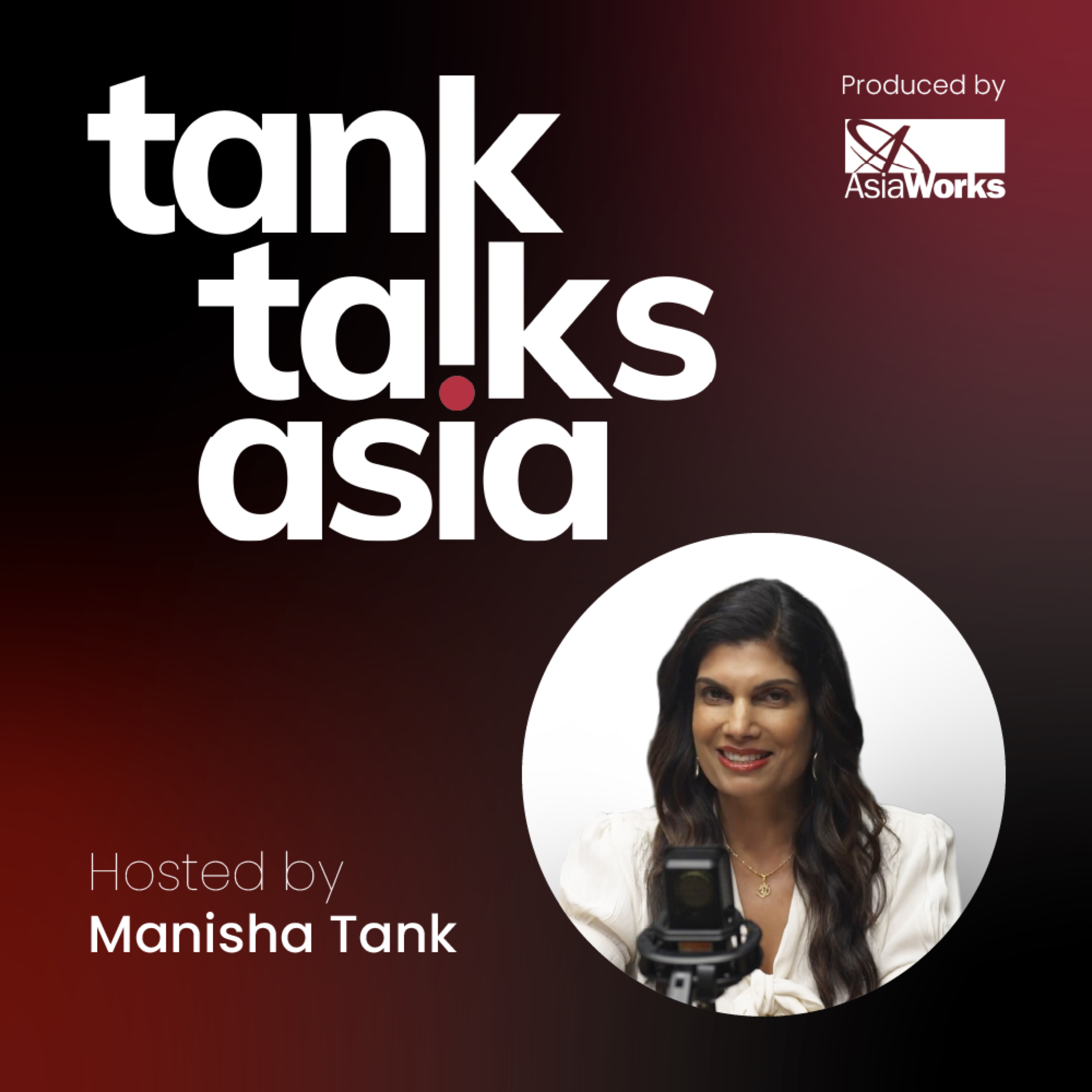
Episode 5
The Real Crisis for Asia Isn't What You Think | Piyush Gupta | Tank Talks Asia
In this episode of Tank Talks Asia, Manisha Tank sits down with former DBS CEO, Piyush Gupta, who reflects on his visionary 15 year tenure at the bank.
He tells us how he’s spending his “retirement” and also discusses everything from Gen-Z challenges and climate realities to regional geopolitics.
Featured Voices
Host: Manisha Tank
Guest: Piyush Gupta
Key takeaways
- Piyush believes India’s moment is here but it’s complex. He sees the country as one of the world’s biggest long-term opportunities, but notes it requires expertise, patience, and cultural understanding.
- He also notes that Southeast Asia’s real short-term crisis isn’t climate. It’s jobs and youth unemployment, as AI reshapes the workforce.
- Piyush urges Gen Z to build skills and take smart risks, and embrace entrepreneurship as traditional jobs shift or disappear.
- Despite rising US–China tensions, he believes a fully bipolar world is unlikely and that Asia will navigate relationships “issue by issue.”
- Piyush talks about the lessons learnt from transforming DBS, and that the company’s leap from a “traditional bank” to a global digital leader, hinged on culture, technology, and picking the right bets.
Chapter heads
01:00 - A New Chapter for Piyush Gupta
How the former DBS CEO is embracing a “retirement” filled with influential roles across business, education, and nature.
04:40 - Why India Matters More Than Ever
Piyush explains why India’s scale, reforms, and digital leap make it a defining opportunity for East Asia.
06:20 - Climate Stress vs. Youth Job Crisis
A look at why jobs—and not climate—could dominate Asia’s agenda in the next decade.
08:30 - Advice for Gen Z
Piyush urges young people to build broad skills and embrace entrepreneurship.
13:20 - Geopolitics in Asia: Navigating the “New Normal”
He argues that countries won’t have to pick sides, predicting an interconnected global order.
16:40 - Lessons from Transforming DBS
Piyush reflects on key tech bets, cultural shifts, and the leadership priorities that helped reshape the bank.
21:20 - Measuring Success
Piyush shares his view on what success really means.
22:50 - Singapore’s Rise as a Financial Powerhouse
He discusses how Singapore became an unlikely global finance hub—and what it needs to thrive in the future.
25:00 - The ‘Real Piyush’ Meme and Handling Global Fame
Piyush explains the story behind an identity mix-up that went viral.
26:45 - Staying Grounded
Piyush believes in living without regrets and talks about how old friends keep him humble.
29:30 - Parting Wisdom & A Symbolic Gift
He shares his grounding rituals, passions, and the story behind the DBS House.
Useful links
https://lkyspp.nus.edu.sg/ips/research/s-r-nathan-fellowship-for-the-study-of-singapore
Don’t miss out
We’re on a mission to bring the real Asia — its thinkers, builders, dreamers, and disruptors — to global ears. So if you know someone who would be a great guest or want to contact the team, please email:
And don’t forget to follow, subscribe, and share so you don’t miss the next episode of Tank Talks Asia.
Tank Talks Asia is an AsiaWorks production.
Transcript
MANISHA: Hello and welcome to Tank Talks Asia. I'm Manisha Tank here at the AsiaWorks headquarters in Singapore. Now, as you know, one of the things we love to do on this show is to try to make sense of what's happening in the region by talking to the people who really get it, and our next guest definitely fits that bill.
Let me introduce you to Piyush Gupta, the newly appointed chairman of Temasek India. This visionary banker is of course also the man who helped steer DBS into the digital age during his 15 year tenure at the top.
We'll be talking to him about what he's been up to since leaving, how he's approaching his exciting new roles, and we’ll also get his take on the big issues in the region that deserve more attention.
Piyush, it's so lovely to see you. How have you been?
PIYUSH: I've been great. Thank you so much for having me here.
MANISHA: The last time I saw you, you were talking about retirement. You have definitely not retired from anything.
PIYUSH: It's true. I don't think I've handled this retirement gig as well as I thought I would. So I wound up with a few more responsibilities than I had anticipated, but nevertheless it's good, you have a little bit more flexibility in your time.
MANISHA: Yeah, absolutely. But you are filling your time. Anyone can go online and they can read about you right now and they'll see that you are an S R Nathan fellow. You have just taken on a new position as, what is it, non-executive director Temasek India, Deputy Chairman Keppel. I think there are others. Can you list them all for us 'cause there's just so much going on.
PIYUSH: I do a few things for the government, which is I'm an alternate member in the Presidential Council of Advisers for President Tharman. I run, I chair SMU, the University, the National Research Foundation Board. So yeah, a few things.
The more commercial ones, as you say Keppel, Mandai. I love Mandai and I'm spending a lot of time with the Mandai gig. And then, you know, I have a couple of more nature related things, which I always wanted to do. So Chairman of the Advisory Board of BirdLife International, which is headquartered out of Cambridge. I'm also on the global steering committee of something called Campaign for Nature. So, yeah, a little bit of this and that, I guess.
MANISHA: So you, and you actually found time to come and sit across from me at the desk. We're so grateful that you're here.
PIYUSH: Well talk about Asia, with AsiaWorks.
MANISHA: I love it. I love it. Okay, well that's exactly what we're gonna do.
What I do extrapolate though, from what you were telling me is a reminder that you sort of have these goals of things that you wanted to do after you left DBS. And you did tell me that one of them was nature. I'm really happy for you that you managed to do that one, because amidst all of this, a lot of people might not know that you know you are, it's all about the bird watching. Bird watching, is this right?
PIYUSH: It started with bird watching. But it’s evolved more broadly into nature. I did a lot of hiking and trekking in the Himalayas as most of people from India did. And yeah, so conservation in general. So that was one of the things I wanted to spend time to in the afterlife.
And the second interest I've had is education. So I wanted a platform in education and my third desire was to keep connected to, you know, country of origin. So if I could find a platform to keep connected to India, that would be a good thing. And yes, I'm happy I've been able to check those three boxes off.
MANISHA: Brilliant. Let's talk a little bit more about the Temasek India part. How did it feel when this opportunity came up and then you were sort of, okay, here is my chance to lean in and do something perhaps that maybe, did you always wanna do that?
PIYUSH: Actually, you know, interestingly Manisha I mean, there's obviously some degree of emotional angle. But for me the bigger agenda has been a very pragmatic, forward-looking business opportunity agenda for all of us.
And it's really born of the fact that India is going to be a significant opportunity for East Asia in the decades to come, for Singapore in particular. And we just have to learn how to lean into India. India is not easy. It's a difficult country to operate in, but it's just huge, 1.4 billion people, a three and a half trillion dollar economy. So we just have to figure how, you know, to do what it takes to be able to leverage that opportunity.
And so for me, as much as the emotional connect of having come from there, it was this more hard-nosed business thinking that we got to maximize this in some way.
MANISHA: Yeah, yeah, absolutely. There is so much global interest in India right now, whether it's amongst investors who are thinking, how do I get a piece of this? As you see India maturing in its economic journey, how do you think the country might change?
PIYUSH: Well, it's very hard to say. I can tell you the good news is that I'm more optimistic about the country today than I've been in a long time. Policies have changed, in fact the latest legislation last week on labor is very significant. But prior to that, the GST legislation, the bankruptcy code legislation, these are all really good pieces of policy change.
If you've been back in India anytime recently, the infrastructure has changed. The roads work, the airports work, the ports work, the digital infrastructure is topnotch. Everybody talks about digital payments and so the possibilities, entrepreneurship. I mean, today, Indian startups is the third largest startup, you know, center in the world. And all the young kids, they're really going for it. So there's a lot of positive opportunity.
The challenges of India well known, it's a messy democracy. And a lot of times there's a big gap between what is said and what actually gets done. And you can really burn your fingers. But frankly, therein lies the opportunity for somebody like me, especially for most of us from East Asia. You know, ethnically most of us from here understand China. Ancestors came from there, et cetera. Most business in East Asia don't have the same connection into India. So to be a pathfinder, navigator, help people, you know, chart their course in India is something people like me can do.
MANISHA: Let's just run through some things that are happening in the region at the moment. Obviously something that's been really big in the news has been the floods. You have traveled around this region so extensively, do you think it's time that we talk about some of these serious issues around intensifying climate change?
PIYUSH: So Manisha, I think nature will obviously a slow fuse challenge.
It's both climate and biodiversity. They're both going to be extremely important in our region. You know, the Sunda Straits is one of the shallowest seas in the world. It's only a 10, 12,000 year old sea. And so rising water levels will impact our part of the world very materially. And with the change in the climate system, climate patterns, whether it's heat on the one side or episodic, you know, flood, storms, et cetera, it will be a big issue.
And so obviously we need to get our minds around that. But I'm also pragmatic. The reality is that for large parts of Southeast Asia, economic development continues to be a more pressing and more urgent challenge. So if you ask me in the next five or 10 years, what will be the big issue in Asia, it's not climate, it is jobs. If you look at what's happened in the last six months, or the last year, in Nepal, in Bangladesh, in Indonesia, in Madagascar, everywhere in the region is Gen Z getting on the streets because there are no jobs.
And you think about AI and the possibility of more job displacement because of AI, this is going to become an even more challenging and even more serious issue. So what happens to governments when you have this clash between a longer term climate agenda or nature agenda and a short term agenda around how do I create jobs for my people and my citizens? You get voted in the short term, voted into power. So I do think that in the short term, the bigger challenge will continue to be the challenge of the economy and creation of jobs for the young kids.
Youth unemployment is at all time highs. And by the way, you know, we sometimes say Asia is blessed, our demographics are fantastic, an average age of 27, 28. Well, that's a double-edged sword because what that also means is that we've got to find jobs for millions of people every year. In India, every year you need 14 to 18 million jobs for the size of the population, and you're creating 1, 2, 3, 4 million jobs. And so that's going to be a powder keg, if you ask me.
MANISHA: I mean, what are three things that you might say to a Gen Z-er who's looking down the barrel of the future and saying, well, AI's taking all the jobs, I'm worried about climate change and, by the way, I don't think my government is doing enough for me.
PIYUSH: Well, I'd say, lemme give you two things, I have to think of the third. But the first thing I tell a lot of the young kids, especially when we are in my SMU role, kids want to know what should we study? Where is the future?
I'm convinced that you have to be very eclectic in your knowledge. You've got to focus on skills, and you got to focus on horizontal learning. Increasingly the computer will know more than you in any specific domain. You press a button and ChatGPT will give you four pages of a thesis on anything. But the capacity to establish context, this capacity to be able to connect the dots, to be able to get the human interface or the thinking around it, that's what would make the difference.
And so one, I tell all the young people, you know, be eclectic. Go back to the principles of education, whether it is Plato or the liberal arts education in the UK, right? Be broad in your approach. That'll help.
The second thing I tell all the young kids is the future of jobs as we know it is going to go.
MANISHA: Wait, wait. What do you mean by that?
PIYUSH: What I mean by that is you think about jobs in large corporations and companies, this was not like a 5,000 thousand or even 500 year old phenomena. Large companies and corporations as we know them are, other than the East India company, it's the last couple of hundred years. In fact, it's a parallel Henry Ford's assembly line. You started seeing Max Weber's hierarchical organization with pyramidal structures and areas of competence, right?
But if you look at the world prior to the assembly line and Max Weber, it was small guilds, self entrepreneurs who worked together and created the goods and activities. Why did it change? Because to get global scale, you needed to get the efficiency of this kind of organization.
Guess what? Today you can get global scale without the challenges that this kind of organization creates, right? It’s well known large organizations produce their own friction. You have silos, you have, you know, work flows horizontally, companies are organized vertically. So in today's day and age, with AI in particular and with agentic, I'm, you know, talking to startups today with half a dozen people already creating hundred million dollars in revenues.
MANISHA: Yeah.
PIYUSH: So you can be globally relevant with a handful of people in today's world.
And so my second message to this, think entrepreneurship, think risk-taking capacity, because the future is going to belong to people who can actually create ideas and scale those ideas.
MANISHA: But Piyush, that doesn't come naturally to all young people, or to all people and it's a really difficult thing to teach. It's a very difficult thing to encourage.
I come across a lot of young people who don't have confidence because this is an overwhelming and challenging world, and also a lot of young people, who they might not be in the elite sphere, they might not have gone to the best colleges or something like that, but that doesn't mean that they're not capable of something.
They just haven't discovered what it is yet. What do you say to them?
PIYUSH: Well, that's my point that you got to first figure what are you good at and what do you like doing? Again, and since we talked about India, actually China as well, but in India today, most of these startups and entrepreneurs are coming from tier three, tier four and tier five cities.
Cities which people like you and I would not even have heard of or dreamt of 20 years ago, you know, all our kind of elite all came from Delhi and Bombay. Today, every small city is throwing out these really smart kids who don't speak great English, but they know what they want, they can create an idea and they can put it to work.
And you're seeing that across all of Asia. The young kids have a lot more confidence and a lot more capacity to be able to put ideas to work in a very different way.
And so my message to young people is this, you know, try and consider, you know, what it takes to be entrepreneurs and risk takers.
Your broader question, how do you get a sense of optimism among young people. And I just reflect that it's very easy to get pessimistic. But the truth is that geopolitics is a challenge. But this is not the worst we've seen. We saw the Cold War, we saw the Second World War, and it just, in the world of social media and echo chambers, it looks like, oh my god, what's happening? But you know, it's been much worse than this.
MANISHA: You get some perspective maybe.
PIYUSH: And get some perspective. If you look at mankind, have you made tremendous progress? Lifespans have gone up from 30, 40 years to 70, 80 years. Health spans have improved dramatically. Number of people below poverty line has crashed.
You know, all of these are good things. So I have a lot of faith in the ingenuity and capacity of humanity to continue to seek and strive and do better.
MANISHA: On that note of doing better, let's talk about China, Japan, Taiwan, the United States, and what is playing out in the theater of East Asia, the South China Sea. Any reflections?
PIYUSH: Well, you know, let me start with the risk obviously, and Asia has prospered tremendously in 50 years of geopolitical stability. Pax Americana you can call it. But nevertheless, we haven't had a war since the mid seventies, and that's been extremely helpful to the region.
And so yeah, anything that creates strife or tension or breakdown or god forbid a hot war would be quite damaging to all of Asia. On the other hand, and that's the optimistic thing, I think it's very hard to get to that kind of situation.
One, I think the world is a lot more integrated today than people would like to believe. Especially, forget global supply chains, so we can talk about that. But communication, you know, everybody is looking at the same communication feed. Everybody knows what's happening in real time. Mobility, labor flows, tourism, there is just a lot more global connectivity than has ever been. And if you go back to supply chains and people talk about can we isolate China?
Well, China is the largest trading partner to over a hundred countries in the world. How do you isolate something like that from the global economic system. It’s very hard to do. So my base case is that while there'll be friction and there'll be certain areas, maybe high tech, semiconductors where, you know, there'll be tariff and non tariff barriers and so on, by and large, people will continue to work in a world where there is alignment and alignment of interest.
And so, yeah, it's easy to, again, start getting very pessimistic about where we are. I like to see the glass is half full.
MANISHA: I like that. I like that. We did have a guest on the show, Sam Olsen, who is a sort of an expert on observing China's relations with the rest of the world. And Sam put it as, countries being red or blue, and he sort of said, you've gotta take a shade of purple.
And that at some point, Southeast Asian nations in particular will have to choose a side. So I'm assuming that you think that's the case? You don't think that's the case? What, which one?
PIYUSH: I don't think that's the case at all. And that's exactly the point I'm making. So, you know, Jay Shankar, the Indian External Affairs Minister, was asked this question about a year or two ago in Bratislava if I remember, saying you have to take a side. And he said, you know, I'm 1.4 billion people, I make my own side.
Now I think that's true for all of Southeast Asia. You know, we are over a billion people and we will do what is pragmatic and what is relevant to us. I do think the world will get to a 19th century kind of world, a little bit mercantilistic, a little bit people looking after their own interests on issues. So you'll, you know, side with the Chinese on some issue and with the Americans on some issue and with neither of them on a third issue.
And yeah, the 19th century Europe saw that, and the UK would be with France on something and Germany on something, and Prussia on something. And in fact you'd have frequent hot wars as well. But yeah, it didn't bring the world to an end. Right?
MANISHA: Yes. On that note, which is a nice positive note, let's talk about your positive 15 years. Was it 15 years at DBS?
PIYUSH: 15, 16 years. Somewhere in between.
MANISHA: 15, 16 years. Okay, something that really struck me was there was a lot that happened that was revolutionary in the space of financial technology, and you are very much given that accolade of being the person who helped DBS transition from what it was to what it is today.
You must have had lots of incidences where people came to you with these sort of ideas out of nowhere that perhaps you'd never thought of before. I wanna get a sense of how you felt about that because you are a perpetually curious person and it strikes me that that must have been so exciting for you, to be playing with everything and all of this new technology.
PIYUSH: It was exciting and continues to be, and people throw tons of things at you. But you know, one of the big challenges of any business person, any leader, is to prioritize and choose what bets you want to make. And to balance the short and the long term.
Because you know, you can throw 40 balls in the air and you can try to catch all of them. You'll never succeed. So you're going to figure the ideas of fun, they're interesting, which are the ones you want to back, which are the ones you want to fool around a little bit, but not go all in and which are the ones you say, you know what? Forget this. It might happen sometime in the future, we’ll worry about it then.
MANISHA: Were there any, forget this moments that you can recall.
PIYUSH: Oh, a lot of them. So for example, when we started thinking about AR, VR, you know, augmented reality, virtual reality, my people kept coming to me saying, let's create this banking avatar, and all our customers will do banking with the avatar online. This was 5, 7, 8 years ago, and I think eventually we will get there. Today with generative AI, you're beginning to see a lot more of that. But when they brought this idea to me eight years ago, I said, it's not going to happen in the foreseeable future. So we'll worry about that when that opportunity comes. Forget about that.
rypto and tokenization. So in:And then area we decided we better go all in was AI. I say AI is now on us, and if you don't master it, we are dead.
MANISHA: Yeah, and you really did get on top of that. There were some characters at DBS who were very much a part of the story. If you could identify one or two people who you felt were pivotal along the way, who would you showcase?
PIYUSH: It'd be hard to call names because, you know, we, everybody…
MANISHA: It was quite a family kind of.
PIYUSH: Yeah, you know, we were about 20 of us in the top tier team and other than a couple who retired, we were all there for 15 years. It was almost a kitchen cabinet. So it's very hard to pick up individuals but if I had to say who really was my partner in the early parts of transformation, it would have to be Dave Gladhill. He was my chief information officer. And he really was my sparring partner in thinking about how we could use technology differently in banking. And at its heart, a large part of the DBS transformation at the beginning was about that. How do you use IT in a very, very different way?
My last callout, I guess the whole team, with my HR head, I mean, culture to me is the most important thing.
In fact my shorthand is you know the most important things ahead - HR and IT. You get the people right and you get the IT right and you're in business. So culture transformation is perhaps the most important thing we had to do. I think everybody played a role.
MANISHA: Now you have a very different scenario because you have one of those portfolio retirements, I suppose. I dunno, do you call it retirement career? I'm not sure.
PIYUSH: Rewirement, rewirement.
MANISHA: But you sort of have all of these different hats that you wear now and so you're working with lots of different teams. But when you were at DBS, of course you talk about these 20 or so people. It was a very sort of family, kind of a culture and feel to it. Do you miss that?
PIYUSH: Well, I'm just working with the people, but you know, I've done 40 plus years of banking. And I had this view that you only live once. You better have a plan for your life. And if you have a plan for your life, I thought is appropriate that I start, you know, trying to do things other than banking in the next phase of my life.
I'm finding actually that it depends on how you think of your role as a chairman on a board or an advisor. You can actually be quite instrumental in helping shape a way of working and helping shape a culture in the companies that you're involved with. And it's my belief that the sense of being part of one team and one family, it's important and you can do that without being a full-time executive.
MANISHA: Yeah. So based on that, I wanted to talk about what do you think success really is? I go to so many events. I talk to so many people and you know, you see a lot of this stuff on LinkedIn and people sort of giving their version of what success is. And I'm never satisfied with what I see because I think there's a lot, there's around power, a lot around money and influence.
But I know for me personally, and it's not my forum to share, success is something else. I'm curious, what do you say it is?
PIYUSH: Well, you know, for me, I've thought about this. So one is, I think you're successful if you believe that you can, you've been able to make impact. And you've been able to make the best impact that you had the capacity to make, right.
I started dot com when I was 40 years old and failed. And for me, it's a seminal moment because I came back to banking. In my years before that success was power, money, promotions. When I came back, I came back with one very clear agenda, that I'm a good banker and I can make a difference.
And so my measure of success started shifting to, can I make a difference? Can I make impact? And the short answer to me is, you know, if you have regrets about things, then maybe you're not that successful. So if you can say, I have no regrets, then maybe you're successful at what you did.
MANISHA: I like that. You can sort of look at yourself in the mirror and feel satisfied with what's looking back at you.
Okay. Let's talk about, I wanna talk a little bit about Singapore. So as an S R Nathan fellow, you have to sort of do, you have to produce some research, right? How does that work? How are you going about figuring out what are the things that you wanna focus on?
PIYUSH: Well, you know, when I signed up to be the S R Nathan fellow, we already agreed that I would focus on, the fellowship is on a study of Singapore, and so I chose my field as a study of our financial services industry.
And the reason I found that interesting Manisha is, you know, people talk of us as an unlikely country. Well, we are really an unlikely financial center. There's no reason for Singapore to be a financial center. We are nothing and yet we are the number two or three FX center in the world. We are number two wealth center in the world. We are an asset management center. We are fixed income center. We are the second largest commodities hub in the world. Think about it. And so to me it was quite interesting to say, go back and say, how did this happen? You know, what did we put in place? Was it just serendipity? Was it policies? Was it people? What caused this to happen?
And then, I think we are at a very important moment in the history of financial services. I think the future of finance will be very different. Technology is a game changer. And so to study a little bit about, you know, what would it take for us to continue to thrive in the future in this world? 'Cause I think these are interesting subjects and that's what I've been focused on.
billionaires in:And if you look at the global ranking, Singapore has jumped 10 places in one year in terms of the number of billionaires here.
Do you think about this at all? Is it something that you think we need to think about for the future?
PIYUSH: Yes, of course. I mean, every country and every government is going to have to be conscious of this. I talked earlier about jobs for the youth. The first cousin of that is Gini coefficient. If you have extraordinary high income and inequality that creates its own sets of challenges. And we are all human beings. We are all looking at the Joneses and say, oh my god, why are these rich people over here? So that's a natural source of tension.
But I think at the same time, you understand that for a country like Singapore, the creation or the residency of wealth over here is a fantastic industry.
MANISHA: Now, look, Piyush, when you sat down, I didn't do one thing, which was to check your ID.
PIYUSH: Oh, I'll show you. This is the real me.
MANISHA: Now look, that was such an incredible story that hit the press here in Singapore. It was quite funny. What did you think when you saw this?
PIYUSH: You know, Manisha, actually, I was in London and it showed up on my feed. This, you know, young girl who ostensibly met this guy or met me in Bali and she'd actually got this whole interview with me and my first reaction was, well, that's exactly what I would've said. So either I spout inanities the whole time, it's easy to mimic or ChatGPT’s very good, so you can just go back and pull what I said.
And then obviously people went after the guy saying he's an imposter. Two days later he came on and said, look, it wasn't me. I told her I'm not Piyush. So then they went after the girl saying, you know, why did she do this? And I was almost tempted at that stage to go back online and say, you know what? I think it's quite a smart thing to do, right? I mean, you want to get eyeballs. But the interesting thing is it became a meme.
So, you know, the real Piyush. And so I, I show up in Heathrow one day and some Caucasian comes and taps me on my shoulder and saying, are you the real one? And I go to Helsinki and three young girls come and ask me, are you the real one? Can we get a selfie? So, some of my colleagues wanted to give me a t-shirt that said, I'm the real one.
MANISHA: That's brilliant. I love it. Well, I hope that you will come back at some point to Tank Talks Asia in your t-shirt.
PIYUSH: All right. I look forward to it at some stage.
MANISHA: Look, I think you just, you just said something there that I really wanted to ask you about. So you said that somebody came up to you, Heathrow Airport, the other side of the world, tapped you on the shoulder. You are a world famous man of finance. How does it feel to be that?
People know who you are all over the world, and we're very proud of Piysuh Gupta, the Singaporean export. What does that feel like?
PIYUSH: It's actually, in some ways it's scary and it sounds trite, but it is humbling. I mean, the fact that, you know, you're well known is got its, you know, you got to treat it with humility.
For me, the biggest value is in how do you stay rooted? I did the commencement speech at NUS some years ago, and I just did it on this one thing, on how do you stay rooted? And that means being authentic to yourself, knowing yourself and continue to have a sense of what you really are.
And as long as you are that, you can stay grounded and you don't get, you don't get lost.
MANISHA: Yeah, absolutely. Before you have to go, staying rooted is very much about the people you hang out with, the books you read, the things you watch, where you spend your spare time. We've already mentioned it, you love nature.
I wanted to find out what would be your advice to stay grounded in this tumultuous world that we live in. What would you say?
PIYUSH: Stay in touch with all the friends you had in school and college and university. They know you for what you really are, and every time you are feeling, you are a little bit more exalted, they pull you down to earth very, very rapidly.
My second piece of advice though is to read. You know?
MANISHA: What are you, what are you reading at the moment?
PIYUSH: I read everything. I'm very eclectic. I read physics, chemistry, geography, anything.
MANISHA: Physics and chemistry?
PIYUSH: Yeah, I read anything. I mean, not deep physics, but anything at all that I can lay my hands on. I think the, you know, the more you read, you realize how much wisdom there is in the world. You gotta have a lot of interests. Yeah, I do have a lot of interests. So, you know, I still am into sport, actively.
MANISHA: Oh, the sport thing now Piyush you've reminded me of something.
So in the way that I'm sitting here interviewing you today, you once interviewed Max Maeder.
PIYUSH: Yes, I did. Yeah, I've done many. So I, you know, I've interacted with a lot of sportsmen in a position you got a chance to. I once remember Roger Federer was in town. He was being hosted by Credit Suisse.
MANISHA: Okay.
PIYUSH: And normally the protocol in banking is you don't go into a competitor banks event. But it was Roger Federer. So I got my buddies at Credit Suisse to invite me, and I went in there and all my clients were there and said, what are you doing here? I said, today, I'm not a DBS person. Today, I'm a Roger Federer fan. I'm a Roger Federer fan.
MANISHA: And I hear he's very gracious.
PIYUSH: He's fabulous. He's fabulous. So I do sports. I read, like I said, I, you know, I do all social media. I'm on Insta, I'm on TikTok, I'm on LinkedIn, I'm on bunch of stuff. I, you know, watch Netflix shows. I do crosswords. I'm good with words, so I can write rhymes and gibberish poetry, and I do crossword puzzles every morning.
MANISHA: I've seen you in an interview make up a limerick on the spot. I'm not gonna make you do it today.
PIYUSH: I'm not doing it today.
MANISHA: Okay. So Piyush on our show we have a little tradition which is we ask our guests to leave us with a little memento for our shelves here. So something for us to remember you by and also a trigger to remind us that you must come back at some stage with your lovely t-shirt.
But what have, what is this that you have brought for us that's on the table.
PIYUSH: So the one I brought, hopefully you can see it in the camera, is it says DBS over here. And it is a DBS house. And over my tenure at DBS, we constructed three versions of the DBS house, because we changed our vision three times to be the best bank in Asia, then to be the best bank in the world, and then finally to be the best bank for a better world.
But to me, this idea of be clear about a mission, be clear about a vision, to figure what their priorities are, and do it in a way that you can put it on a single sheet of paper, that's really important. So the top of this says live more, bank less. Which is a brand promise. The idea is, you know, if you can make banking so effortless, it become the fun thing to do, you bank less, but you can live more.
MANISHA: For those who cannot see this, who might be listening. Yeah, there's lots of really good stuff on here. My favorite being joyful customers.
PIYUSH: Joyful customers, exactly right.
MANISHA: All I'm gonna do is say thank you because it's been so kind of you to come in and spare some time with us, and I will let you go back to wearing the many hats that you wear.
MANISHA: We are so grateful to Piyush for sharing all of his knowledge and expertise with us on so many different subjects. That is it though for this episode.
I'm Manisha Tank. From me and the rest of the team, thank you so much for listening and please don't forget to subscribe and follow Tank Talks Asia. That way you'll be supporting our mission to bring you the story of what's happening here in Asia to the rest of the world and you'll never miss an episode.
Tank Talks Asia is an AsiaWorks production.